
Introduction
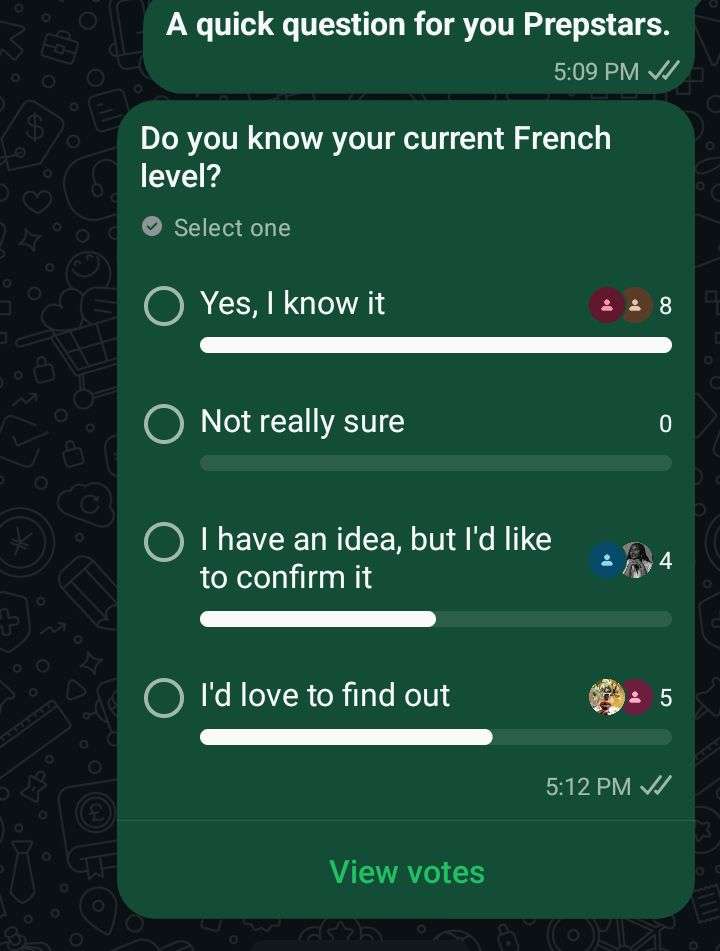
We recently asked members of our WhatsApp community if they knew their current French level. Out of the 17 people who voted, 8 said they knew their level, while 9 were unsure.
If you’re learning French or preparing for the TEF exam, it’s important to know your current proficiency level. This will help you track your progress, identify areas where you need to improve and understand what you need to work on next.
French proficiency is measured using the Common European Framework of Reference for Languages (CEFR). It has six levels, from A1 (beginner) to C2 (proficient).
But what does each level mean? What should you be able to do at each stage, and how can you find out your current French level? Let’s find out.
What are the 6 French language levels (A1 to C2)?
The 6 French proficiency levels fall into 3 categories: Basic User (A1 and A2), Independent User (B1 and B2) and Proficient User (C1 and C2).
Each level shows how well you can understand and communicate in French, from simple everyday expressions to complex discussions. Let’s look at what you should be able to do at each stage. stage.
A1 – Beginner
A1 is the starting point for anyone learning French from scratch. At this level, you get familiar with basic vocabulary, simple expressions and everyday greetings.
At this stage, you should be able to:
- Introduce yourself and share basic personal information.
- Understand simple words and expressions when someone speaks slowly and clearly.
- Ask and answer basic questions about yourself, your family and your surroundings.
- Use simple phrases to communicate everyday needs.
How to progress from A1 to A2
Build your vocabulary around familiar topics such as food, family, shopping, work and daily activities. Learn how to construct simple sentences, ask questions and talk about your routine. Listen to short French conversations on YouTube and find a French-speaking partner you can practise with regularly.
A2 – Elementary
At A2, you can communicate in simple everyday situations. You understand frequently used expressions and can exchange basic information about familiar subjects.
You should be able to:
- Talk about your family, work, hobbies and daily routine.
- Understand common expressions and short, straightforward messages.
- Describe your immediate environment.
- Handle simple conversations, such as ordering food or asking for directions.
How to progress from A2 to B1
Start longer conversations and practise expressing your thoughts in connected sentences. Expand your vocabulary, practise different verb tenses and listen to French conversations on familiar topics. You can also use French learning books, such as Grammaire progressive du français, to strengthen your grammar and sentence construction. Practise describing past experiences, future plans and personal opinions.
B1 – Intermediate
At B1, you become a more independent French speaker. You can understand the main ideas on familiar topics and communicate in everyday situations without a translator.
You should be able to:
- Understand the main points of conversations about topics you’re familiar with.
- Describe experiences, events and plans.
- Explain your opinions and give reasons behind them.
- Manage common situations you may encounter while travelling in a French-speaking country, like ordering food, booking a room, or asking for directions.
How to progress from B1 to B2
Work on expressing yourself more clearly and developing your arguments. Practise discussing different subjects, including topics you know less well. Listen to longer recordings, read more complex texts and improve your grammar, pronunciation and vocabulary.
B2 – Upper-intermediate
At B2, you communicate with greater fluency and confidence. You can understand complex texts, follow detailed discussions and talk with fluent French speakers without much difficulty.
You should be able to:
- Understand the main ideas of complex texts on concrete and abstract topics.
- Communicate spontaneously without frequent pauses to find words.
- Explain and defend your opinions.
- Write clear, detailed texts on different subjects.
How to progress from B2 to C1
Focus on expressing complex ideas more naturally and accurately. Read longer articles, follow French news and interviews, and join discussions on professional, academic and social topics. Pay attention to implied meanings, expressions and the different ways people speak in formal and informal situations.
C1 – Advanced
At C1, you can speak French effectively in social, academic and professional situations. You understand demanding texts and express yourself fluently without constantly searching for words.
You should be able to:
- Understand long and complex texts, including implied meanings.
- Express yourself spontaneously and fluently.
- Use French flexibly for professional, academic and social purposes.
- Present detailed arguments and explain complex ideas clearly.
How to progress from C1 to C2
At this stage, refine how you communicate. Read advanced French literature, follow detailed discussions and practise expressing subtle differences in meaning. Work on summarising information from different sources with accuracy and precision.
C2 – Proficient
C2 is the highest level on the CEFR scale. At this stage, you understand almost everything you hear or read, and you communicate with a high degree of fluency and precision.
You should be able to:
- Understand virtually all forms of spoken and written French.
- Summarise information from different sources.
- Express yourself spontaneously and accurately.
- Recognise subtle differences in meaning and use the language appropriately in complex situations.
At this level, keep your proficiency strong, expand your knowledge and continue to refine how you use the language.
How do I know if I have moved from A1 to A2 or B1 to B2?
The best way to measure your progress is to look at what you can do in French, not at how many lessons you have finished or how many words you have memorised.
For instance, moving from A1 to A2 means you can communicate more comfortably in everyday situations. You begin to move beyond simple introductions and basic expressions.
You’ll see similar progress when you move from B1 to B2. You’ll be able to hold more complex conversations, express your opinions in greater detail, and communicate more spontaneously.
To assess your progress, look at these 4 areas.
1. Listening
Pay attention to how well you understand French conversations without a translation. Can you follow the main points of an audio recording or understand what someone says about a familiar subject?
2. Speaking
Consider how comfortably you express your thoughts without translating every sentence from English. Can you hold a conversation, explain your opinions and respond to questions?
3. Reading
Check your ability to understand French messages, articles, and longer texts. Can you recognise the main ideas without reaching for a dictionary every time you encounter an unfamiliar word?
4. Writing
Check how well you communicate your thoughts in written French. Are your sentences and paragraphs clear and organised? Do you use appropriate grammar and vocabulary?
When you assess these 4 skills, you will have a clearer picture of your progress. You can also ask your French tutor to evaluate your performance, point out your weaknesses and recommend what to work on before you move to the next level.
What is the best French level to take the TEF or TCF exam?
We usually recommend B2 as a good level to start your TEF preparation and work towards taking the TEF or TCF exam. However, the level you need depends on your immigration programme and the scores required for your application.
For example, Canada’s French-language proficiency category under Express Entry requires candidates to score at least NCLC 7 in all 4 language abilities: listening, speaking, reading and writing.
The Federal Skilled Worker Program also requires at least NCLC 7 in all 4 language abilities if French is your first official language.
Your NCLC level comes from your official TEF or TCF results, not from your CEFR level alone. So, even if you have reached B2 in your French classes, you must confirm that your exam scores meet the requirements of your immigration programme.
Before you book your TEF or TCF exam, check that you can do the following:
- Understand spoken French in different situations, including conversations and longer audio recordings.
- Express your thoughts clearly and respond to questions without struggling to find words.
- Understand different types of written texts and identify their main ideas.
- Write organised texts, express your opinions and support your arguments with relevant examples.
Most importantly, don’t rush to book your exam because you have completed a particular level. Ask your tutor to assess your performance and confirm that you are ready before you book the exam.
Frequently asked questions (FAQs)
1. Can I learn French in 3 months?
Yes, you can learn basic French in 3 months. However, it takes about 10 to 12 months to become fluent or reach an advanced level. Your progress depends on your starting level, your consistency and the time you set aside for practice.
2. Where can I take a free French level test online?
There are many free online tests, but an online test only gives you an indication of your proficiency. You still need an expert to assess your speaking, listening, reading and writing so that you know which areas to improve.
3. How many hours do I need to become fluent in French?
There is no fixed number of hours because your starting level, study habits and daily practice determine how quickly you progress. Consistent practice and structured lessons will help you improve faster.
Conclusion
The best way to know your French proficiency level is to get an assessment from an expert tutor who can evaluate your progress, identify your weaknesses and guide your preparation so you are ready to take your TEF or TCF exam.
If you want to know your French level and need help preparing for your TEF or TCF exam, send us a DM today.